SeeBlu
Lead developer of SeeBlu
A TikTok-style app for meeting people in Nigeria through short videos, photos and one tap to connect
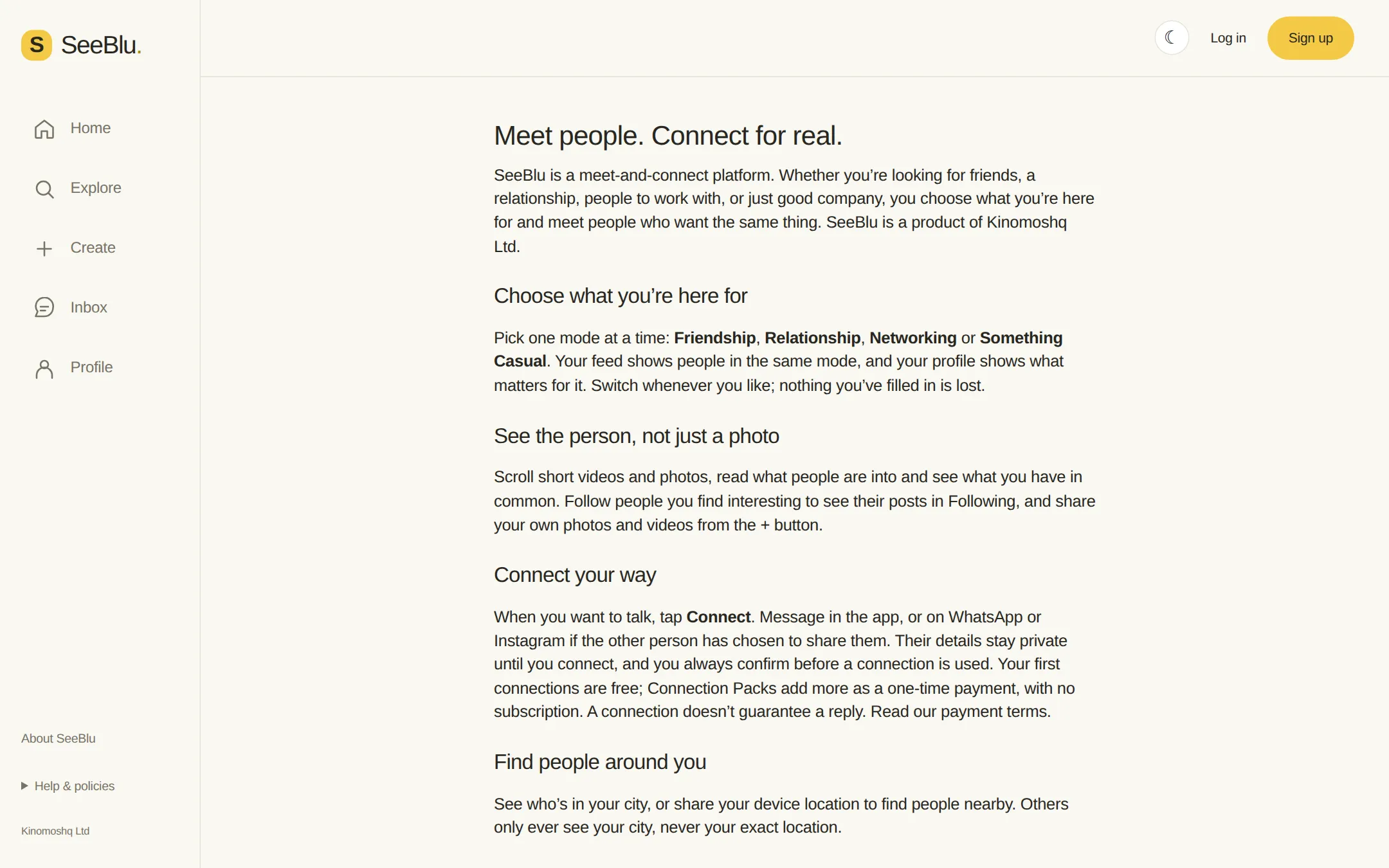
SeeBlu is a meet-and-connect platform. People choose what they’re there for (friendship, a relationship, networking or something casual), scroll short videos and photos from people looking for the same thing, and tap Connect when they want to talk.
I founded it and built it end to end, from the product and the design to the servers.
What I built
- A short-video and photo feed with For you, Following and Nearby tabs. Nearby uses the city only, never an exact location.
- Profiles with modes, interests and identity verification.
- Chat that feels live: an online dot, “last seen”, and voice notes up to 90 seconds, converted to AAC with ffmpeg so they play on every phone.
- An installable app (PWA) with push notifications on Android and iPhone.
- Connection Packs: one-time payments instead of a subscription.
- A staff studio in Wagtail for moderation, reports and site content.
- Bot protection with Cloudflare Turnstile and rate-limited logins.
How it runs
SeeBlu is two parts: a static site on Cloudflare Pages that people open, and a Django API on a server I already had. The API is Django 5 and Wagtail 7 on PostgreSQL, and uploads and voice notes are checked by file signature before they are stored.
Why I split it
It came down to cost. I didn’t want to pay for a new server and a new database for an app that’s still in testing. Kinomos already runs on a DigitalOcean droplet with a managed PostgreSQL cluster, so I looked into reusing that backend. SeeBlu’s API now runs in its own container on the same droplet, with its own database inside the existing cluster. No new server and no new database to pay for.
That left the pages. Both GitHub Pages and Cloudflare Pages host a static site for free, so I compared the two and went with Cloudflare:
- HTTPS that looks after itself. Cloudflare issues the SSL certificate and renews it on its own, so the site can’t go down because a certificate expired. I wanted the same on the API side, so a daily job renews its certificate and only reloads the server when something actually changed.
- Security headers. Cloudflare lets me set my own, including a strict Content-Security-Policy. GitHub Pages doesn’t let you set headers.
- Private code. The SeeBlu repo is private, and GitHub Pages only publishes private repos on a paid plan.
- Redirect rules that send paths like
/media/straight to the API. - Turnstile, the bot check on sign-up and login, is Cloudflare’s too.
- Smaller things: no bandwidth cap on the free plan (GitHub Pages has a soft limit of 100 GB a month), and pages are served from Cloudflare’s network close to the visitor.
Rebuilding every page
My first try was a hand-written login page, and it didn’t look like the real one. So I changed approach: a build command renders every static page from the same Django templates the server uses, so the static site and the app show exactly the same thing. Pages that change per person load live through the API.
I kept security in view the whole way:
- The session travels in a request header, not a cookie, so another website can’t make requests as a signed-in member.
- No inline scripts, so the Content-Security-Policy can block anything injected.
- Bots meet Turnstile on sign-up and login, plus rate limits per network and per account.
- Photos that aren’t public yet load through short-lived signed links.
One thing caught me out: Cloudflare kept serving an old copy of a page I had removed, from its cache. Now every address has a real file behind it.
If you already have a backend, put the next app’s pages on a static host and point them at it. It added nothing to my hosting bill.